2022-08-31
Electronic Newspaper Internet and Seoul Business Agency joint project 'Road to Unicorn in Seongsu'①
[Joint planning by Electronic Newspaper Internet and Seoul Business Agency] In the era of the 4th industrial revolution, attempts to become next-generation core companies with various ideas are continuing. Among them, some companies that have entered commercialization with outstanding competitiveness are growing into ' unicorn companies' and leading new changes in the industry.
Seeing this, some companies, VCs (venture capital), and the government are continuing their efforts to discover and support 'unicorn companies'.

△Kim Min-su, CEO of Korea Fisheries Research & Development Institute
In line with the industry, our magazine is cooperating with 'Seoul Startup Hub Seongsu', which supports various potential industry leaders, to present the 'Road to Unicorn in Seongsu' section, consisting of a total of 10 episodes, to highlight potential unicorn companies.
The first episode will cover the 'smart aquaculture' company Korea Fisheries Research and Development Institute (CEO Kim Min-soo).
Korea Fisheries Research and Development Institute is a company that is promoting 'Smart Aqua Farm' as its main product, developed by a research team with a history in aquaculture and IoT , led by CEO Kim Min-soo, an aquaculture disease management specialist who wrote a research paper on aquaculture environment based on the Bio-Floc system.
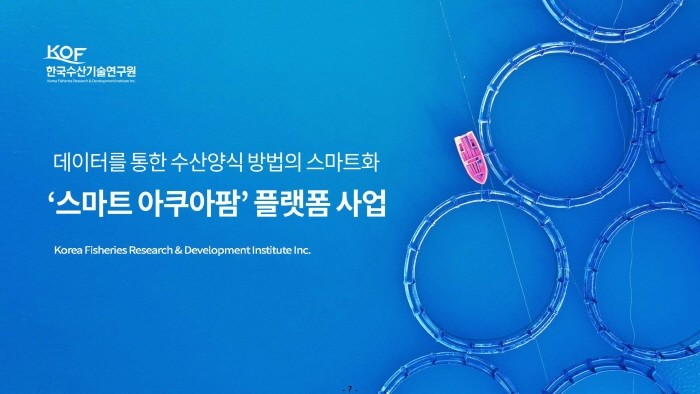
Photo = Provided by Korea Fisheries Research & Development Institute
'Smart Aqua Farm' is a smart aquaculture platform that combines a system that combines big data
-based aquaculture farm know-how and domestic environmental indicators with an IoT (Internet of Things) frame suitable for growth. This platform is expected to organize the uneven distribution rate of aquaculture resources with different growth methods for each aquaculture farmer, while fundamentally solving the water quality environment and providing a stable food supply for consumers, as well as reasonably equipping feed and equipment suitable for growth. As the test conducted on an actual 30-pyeong scale was successful, an expansion test to an average aquaculture environment of 300 pyeong is also being prepared.
- Startup story?
▲ While studying and researching aquaculture life, I felt a vision when I saw that aquaculture is still being conducted in an analog form in Korea compared to overseas where the aquaculture industry is developed.
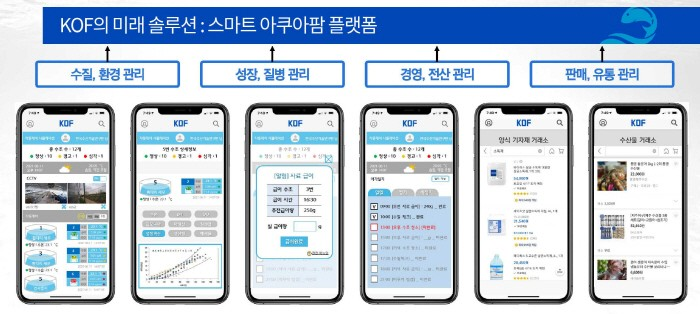
Photo = Provided by Korea Fisheries Research & Development Institute
-What has been your recent activity?
▲First, we have been refining the technical aspect with the title of 'Smart Aqua Farm'. By combining the hardware of the aquaculture equipment with the software based on big data that we studied, we have standardized the related contents, and we have successfully conducted a test on a 30-pyeong scale, which is about 10% of the average aquaculture scale.
-Were there any difficulties in starting the business? How did you overcome them?
▲Basically, since the goal is quite big, a lot of time and money are needed. So we had some difficulty in procuring them. We also had difficulty in persuading the aquaculture operators who had been working conventionally.
We judged that these issues would be easier to solve as more successful cases emerge, so we are currently focusing on persuading direct aquaculture farms and second-generation aquaculture operators. In addition, we are working on systematizing productivity through collaboration with Gangwon-do's smart aquaculture cluster industry.
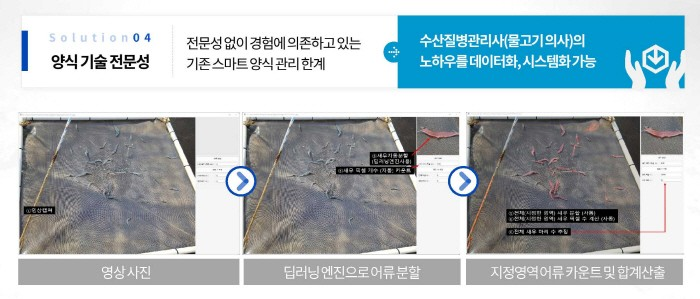
Photo = Provided by Korea Fisheries Research & Development Institute
- Have you had any actual successes?
▲ People often say seasonal fish. We are gradually achieving success in raising it to the point where we can eat it every month through standardization of farming. We
recently achieved success by supplying farmed summer shrimp to Gangwon-do Nonghyup Hanaro Mart. We are currently expanding the range of fish species to salmon and other high-demand species. We are also actively pursuing opportunities for solidarity with large corporations based on these results.
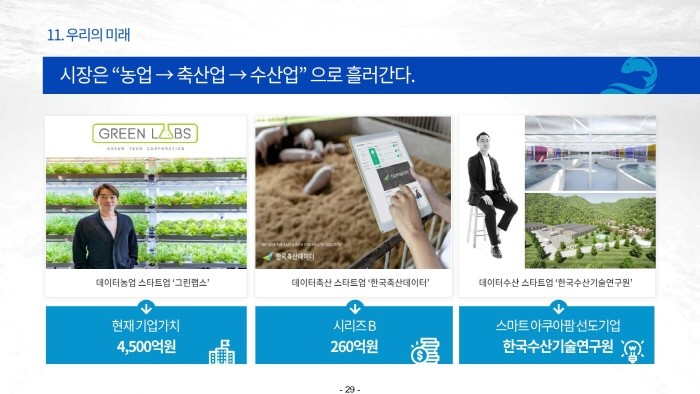
Photo = Provided by Korea Fisheries Research & Development Institute
-What are your future goals?
▲Along with the changes in the ecological environment, the fishing industry is gradually changing from catching to farming. In this situation, the goal is to build a smart aquaculture platform that anyone can easily do anywhere by linking equipment, production purchases, and finance based on a standardized platform and grow together. If our smart aqua farm is established, I am confident that producers will have a stable source of income and consumers will be guaranteed safe food.
Electronic Times Internet Reporter Park Dong-sun (dspark@etnews.com)
View the Full Article Text




2022-08-31
Electronic Newspaper Internet and Seoul Business Agency joint project 'Road to Unicorn in Seongsu'①
[Joint planning by Electronic Newspaper Internet and Seoul Business Agency] In the era of the 4th industrial revolution, attempts to become next-generation core companies with various ideas are continuing. Among them, some companies that have entered commercialization with outstanding competitiveness are growing into ' unicorn companies' and leading new changes in the industry.
Seeing this, some companies, VCs (venture capital), and the government are continuing their efforts to discover and support 'unicorn companies'.
△Kim Min-su, CEO of Korea Fisheries Research & Development Institute
In line with the industry, our magazine is cooperating with 'Seoul Startup Hub Seongsu', which supports various potential industry leaders, to present the 'Road to Unicorn in Seongsu' section, consisting of a total of 10 episodes, to highlight potential unicorn companies.
The first episode will cover the 'smart aquaculture' company Korea Fisheries Research and Development Institute (CEO Kim Min-soo).
Korea Fisheries Research and Development Institute is a company that is promoting 'Smart Aqua Farm' as its main product, developed by a research team with a history in aquaculture and IoT , led by CEO Kim Min-soo, an aquaculture disease management specialist who wrote a research paper on aquaculture environment based on the Bio-Floc system.
Photo = Provided by Korea Fisheries Research & Development Institute
'Smart Aqua Farm' is a smart aquaculture platform that combines a system that combines big data
-based aquaculture farm know-how and domestic environmental indicators with an IoT (Internet of Things) frame suitable for growth. This platform is expected to organize the uneven distribution rate of aquaculture resources with different growth methods for each aquaculture farmer, while fundamentally solving the water quality environment and providing a stable food supply for consumers, as well as reasonably equipping feed and equipment suitable for growth. As the test conducted on an actual 30-pyeong scale was successful, an expansion test to an average aquaculture environment of 300 pyeong is also being prepared.
- Startup story?
▲ While studying and researching aquaculture life, I felt a vision when I saw that aquaculture is still being conducted in an analog form in Korea compared to overseas where the aquaculture industry is developed.
Photo = Provided by Korea Fisheries Research & Development Institute
-What has been your recent activity?
▲First, we have been refining the technical aspect with the title of 'Smart Aqua Farm'. By combining the hardware of the aquaculture equipment with the software based on big data that we studied, we have standardized the related contents, and we have successfully conducted a test on a 30-pyeong scale, which is about 10% of the average aquaculture scale.
-Were there any difficulties in starting the business? How did you overcome them?
▲Basically, since the goal is quite big, a lot of time and money are needed. So we had some difficulty in procuring them. We also had difficulty in persuading the aquaculture operators who had been working conventionally.
We judged that these issues would be easier to solve as more successful cases emerge, so we are currently focusing on persuading direct aquaculture farms and second-generation aquaculture operators. In addition, we are working on systematizing productivity through collaboration with Gangwon-do's smart aquaculture cluster industry.
Photo = Provided by Korea Fisheries Research & Development Institute
- Have you had any actual successes?
▲ People often say seasonal fish. We are gradually achieving success in raising it to the point where we can eat it every month through standardization of farming. We
recently achieved success by supplying farmed summer shrimp to Gangwon-do Nonghyup Hanaro Mart. We are currently expanding the range of fish species to salmon and other high-demand species. We are also actively pursuing opportunities for solidarity with large corporations based on these results.
Photo = Provided by Korea Fisheries Research & Development Institute
-What are your future goals?
▲Along with the changes in the ecological environment, the fishing industry is gradually changing from catching to farming. In this situation, the goal is to build a smart aquaculture platform that anyone can easily do anywhere by linking equipment, production purchases, and finance based on a standardized platform and grow together. If our smart aqua farm is established, I am confident that producers will have a stable source of income and consumers will be guaranteed safe food.
Electronic Times Internet Reporter Park Dong-sun (dspark@etnews.com)
View the Full Article Text